
Every stranded cable begins with a fundamental engineering decision: how to arrange individual wires into a configuration that delivers the required combination of electrical performance, mechanical strength, and physical flexibility. The machine that executes this decision — the cable stranding machine — is one of the most technically consequential pieces of equipment in any cable production facility. Yet despite its central importance, the stranding machine is often poorly understood outside of specialist circles.
This article provides a thorough examination of cable stranding technology: how stranding machines work, what distinguishes the main machine types from one another, which applications each is best suited for, and what manufacturers should know when evaluating stranding equipment for their production lines.
The Engineering Logic Behind Stranding
To appreciate why stranding machines matter, it helps to understand what stranding actually achieves from an engineering standpoint.
A solid conductor — a single wire of a given cross-section — is relatively stiff and brittle under repeated bending. In most cable applications, this is a significant disadvantage. Cables must be routed around corners during installation, flexed repeatedly in moving machinery, coiled onto drums during storage and transport, and sometimes subjected to vibration throughout their service life. A solid conductor is poorly equipped to handle these demands without cracking or breaking.
Stranding solves this problem by distributing the conductor cross-section across multiple smaller wires twisted together in a helical pattern. When a stranded conductor is bent, the individual wires can shift slightly relative to each other, absorbing the mechanical strain that would otherwise fracture a solid conductor. The greater the number of wires — and the smaller each individual wire diameter — the more flexible the finished conductor becomes.
Stranding also has electrical implications. The helical twist of the wires affects the effective length of each conductor element relative to the cable axis, which influences the cable’s inductance and resistance characteristics. These parameters are controlled through the lay length — the axial distance over which each wire completes one full revolution — which is a primary variable managed by the stranding machine.
Getting these parameters right, consistently, across thousands of metres of production output, is what cable stranding machines are designed to do.
The Four Main Stranding Machine Architectures
Cable stranding machines are built around four fundamentally different mechanical architectures, each reflecting a different approach to the challenge of twisting multiple wires together while controlling tension, lay length, and material stress.
Rigid Frame Stranders
In a rigid frame strander, the wire bobbins are mounted in cradles arranged around the machine axis. The entire cradle assembly rotates, applying twist to the wire bundle as it is drawn forward through the machine. The wires themselves do not rotate about their own axes during this process.
This architecture delivers high torque capacity and robust construction, making rigid stranders well suited to large conductor cross-sections — particularly copper and aluminium power cable conductors where the individual wire diameters are relatively large and the required lay lengths are long. The trade-off is limited rotational speed, which constrains throughput compared to faster machine types.
Rigid stranders are the workhorses of power cable conductor production. Their strength, reliability, and straightforward maintenance requirements make them a practical choice for manufacturers whose production is concentrated in medium to large conductor sizes.
Planetary Stranders
A planetary strander introduces a back-twist mechanism: as the bobbin assembly rotates around the machine axis, a compensating rotation is applied to each individual bobbin to prevent the wire from twisting about its own axis. This keeps the internal stress in the wire at a minimum throughout the stranding process.
This back-twist capability is essential for processing torsion-sensitive materials — optical fibre elements, foil-screened pairs, and certain specialty conductors — where any residual torsional stress would degrade performance or cause premature failure. It also enables the stranding of pre-insulated cores into multi-core cable assemblies without damaging the insulation.
Planetary stranders are more mechanically complex than rigid frame machines and correspondingly more expensive. But for the cable types that require their specific capabilities — particularly multi-core control and instrumentation cables, and optical fibre cables — there is no practical alternative.
Tubular Stranders
The tubular strander takes a different approach to achieving high production speed. Rather than rotating a heavy assembly of loaded bobbins, it rotates a lightweight tube through which the wires pass. The bobbins remain stationary on a fixed payoff rack, and the rotating tube applies twist to the wire bundle as it exits the machine.
Because the rotating mass is much lighter than in a rigid frame machine, tubular stranders can achieve significantly higher rotational speeds — translating directly into higher line speeds and greater throughput. They are particularly well suited to smaller conductor sizes where the individual wire diameters are fine enough to allow the compact winding on small bobbins that tubular strander operation requires.
For high-volume production of communication cables, small power cables, and instrumentation cables, the tubular strander’s combination of speed and efficiency is difficult to match.
Bow Stranders and Bunching Machines
Bow stranders and bunching machines represent the lightest end of the stranding machine range. In a bow strander, a small number of wires — typically two to seven — are twisted together by passing them through a rotating bow-shaped guide. In a bunching machine, a larger number of fine wires are gathered and twisted in a single operation without precise control of lay length.
These machines are optimised for fine wire processing: flexible conductors for appliance leads, thin data cables, and similar applications where conductor flexibility is the primary objective and precise lay length control is secondary. Their compact footprint and relatively low capital cost make them accessible to smaller producers and specialised operations.
What Determines Stranding Quality?
Producing a stranded conductor that meets specification requires consistent control of several interrelated variables throughout the production run. Understanding these variables is essential for evaluating stranding machine capabilities.
Lay length consistency: The lay length — the distance over which each wire completes one full helical revolution — must be held within tight tolerances along the entire cable length. Variation in lay length affects both the electrical characteristics and the physical dimensions of the conductor. Modern stranding machines use closed-loop control systems to maintain lay length even as line speed varies during acceleration and deceleration.
Tension uniformity: Each wire in the stranded bundle must be maintained at the correct tension throughout production. Unequal tension causes some wires to be pulled tighter than others, creating an uneven distribution of stress within the conductor and potentially causing premature wire breakage in service. Tension control systems — from simple mechanical brakes to sophisticated servo-driven active tension management — vary significantly in their precision and consistency.
Wire surface quality: Stranding machines subject wires to repeated bending and contact with machine guides and dies. Sharp edges on capstans or guides can score the wire surface, creating stress concentration points that reduce the conductor’s fatigue life. The design and condition of contact surfaces is a meaningful differentiator between machine quality levels.
Compaction: For many conductor types, the stranded bundle is passed through a compacting die that presses the wires together, reducing the overall conductor diameter and increasing packing density. The compaction die geometry and the precision of its alignment affect the roundness and dimensional consistency of the finished conductor.
Application Landscape: Matching Machine Type to Cable Category
The diversity of stranding machine types reflects the diversity of the cables they produce. Different cable categories impose fundamentally different requirements on the stranding process.
High-voltage and medium-voltage power cables require large conductor cross-sections — often 150mm² and above — built from relatively large individual wires. Long lay lengths and high torque capacity are more important than rotational speed. Rigid frame stranders dominate this segment.
Low-voltage power and distribution cables span a wide range of conductor sizes, from small residential wiring conductors to large industrial feeder cables. Both rigid frame and tubular stranders are used across this range, with the choice depending on the specific cross-sections in the product mix and the required production volumes.
Control and instrumentation cables typically consist of multiple small-diameter insulated cores assembled in a multi-layer stranded construction. The need to strand pre-insulated cores without torsional damage points to planetary stranders for the core assembly stage.
Data and telecommunications cables require precise control of the twist parameters of individual wire pairs, which directly affects the cable’s high-frequency electrical performance. Dedicated pair twisting machines and planetary stranders are used for this application.
Renewable energy cables — including those used in wind turbine towers, solar array connections, and electric vehicle charging infrastructure — typically require flexible conductors with fine wire stranding. High-speed tubular stranders and bunching machines serve this segment.
Subsea and offshore cables present some of the most demanding stranding requirements: very large conductor cross-sections, extremely long production lengths, and the need for precise lay length control to meet strict electrical specifications. Specialised large-frame rigid stranders are used for these applications.
Technology Integration in Modern Stranding Machines
The capabilities of stranding machines have expanded significantly with the integration of digital control systems, sensor technology, and connectivity features. These advances affect both the quality of the output and the economics of operation.
Digital lay length control replaces mechanical gear changes with electronically controlled drive systems that can set and maintain any lay length within the machine’s operating range. This eliminates the setup time associated with gear changes and makes the machine far more flexible for operations with varied product mixes.
Active tension management uses servo-driven payoff systems that continuously adjust wire tension in response to real-time measurements. This provides superior tension uniformity compared to passive braking systems, particularly at the high line speeds that modern machines are capable of achieving.
In-line diameter measurement uses laser or optical gauges to measure the conductor diameter continuously during production. When the measured diameter deviates from specification, the control system can adjust compaction die settings or alert the operator before a significant length of out-of-specification conductor is produced.
Production data recording captures key process parameters — line speed, lay length, tension values, diameter measurements — for every metre of conductor produced. This data supports quality certification, enables traceability, and provides the raw material for process improvement analysis.
Remote diagnostics allow the machine manufacturer’s technical support team to connect to the machine’s control system remotely, diagnose faults, and often resolve issues without requiring a site visit. This capability has a significant impact on support response times and overall equipment availability.
Evaluating Stranding Machines: A Practical Checklist
For cable manufacturers assessing stranding machine options, the following questions provide a structured framework for comparison:
Processing range: What conductor sizes does the machine handle — minimum and maximum cross-section? How many bobbins can it accommodate, and what are the maximum bobbin dimensions and loaded weight?
Speed and throughput: What are the maximum and minimum rotational speeds? What line speeds are achievable for the conductor sizes in the target product range? How do these figures compare across the full production range, not just at the peak specification?
Lay length range and control: What lay lengths can the machine achieve? How is lay length set and controlled — mechanical, electronic, or closed-loop? What is the achievable lay length tolerance?
Tension control system: What type of tension control does the machine use for each payoff position? What is the tension range, and how uniform is tension control across the bobbin unwind cycle?
Changeover time: How long does it take to change the bobbin load for a new production run? What is the procedure for changing lay length? Can these operations be performed simultaneously?
Control system platform: What control hardware and software does the machine use? Is it a widely-used industrial platform with available support and spare parts? What data outputs does it provide, and in what formats?
Supplier support: What installation and commissioning services are provided? What training is included? What are the typical response times for technical support, and what remote diagnostics capabilities are available?
The Stranding Machine in Context: Integration with the Production Line
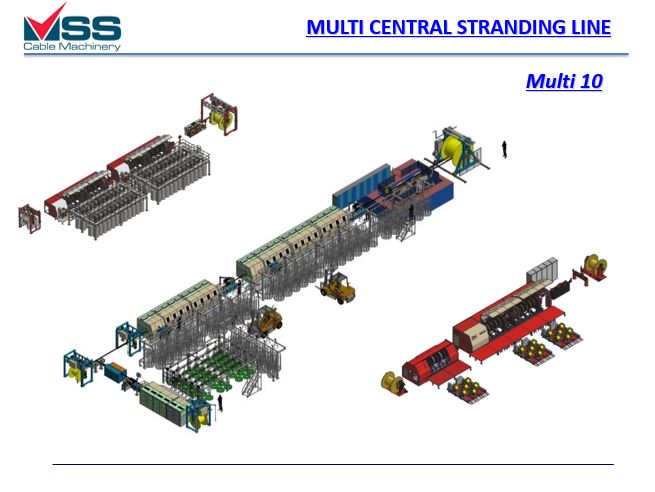
A stranding machine does not operate in isolation. Its performance is constrained by the quality of the wire it receives from upstream rod breakdown and wire drawing operations, and its output directly determines what is achievable in downstream insulation, assembly, and armouring processes.
Conductor dimensional consistency from the stranding machine — particularly outer diameter roundness and lay length uniformity — directly affects the ability of the extrusion line to apply insulation at consistent thickness. Variations in conductor geometry translate into variations in insulation eccentricity, which in turn affect the cable’s dielectric performance and its compliance with the relevant product standard.
This interdependence means that stranding machine performance cannot be evaluated entirely in isolation from the broader production line context. The best stranding machine in the world will deliver disappointing results if fed with inconsistently drawn wire or followed by an extrusion line whose tooling geometry is not matched to the conductor dimensions it produces.
For manufacturers planning a new production line or a significant upgrade, considering the stranding machine as a component of an integrated system — rather than as a standalone piece of equipment — leads to better outcomes.
Conclusion
Cable stranding machines occupy a central position in the cable manufacturing process, performing a function that is both technically demanding and directly consequential for the quality and performance of the finished cable. The diversity of stranding machine architectures — rigid frame, planetary, tubular, and bow — reflects the equally diverse range of cable types they serve, each with its own specific requirements for conductor construction, mechanical properties, and electrical performance.
For manufacturers evaluating stranding equipment, the most productive approach combines a clear definition of the conductor specifications and production volumes to be achieved with a rigorous technical assessment of the machines under consideration — covering processing range, speed capability, tension and lay length control, data integration, and supplier support. Machines that perform well against all of these criteria consistently deliver better results over their operational life than those selected primarily on the basis of initial price.
MSS Machinery’s stranding solutions are designed with these priorities in mind — combining robust mechanical construction with precise digital control systems and the technical support infrastructure that cable manufacturers need to keep their production lines operating at peak performance.