
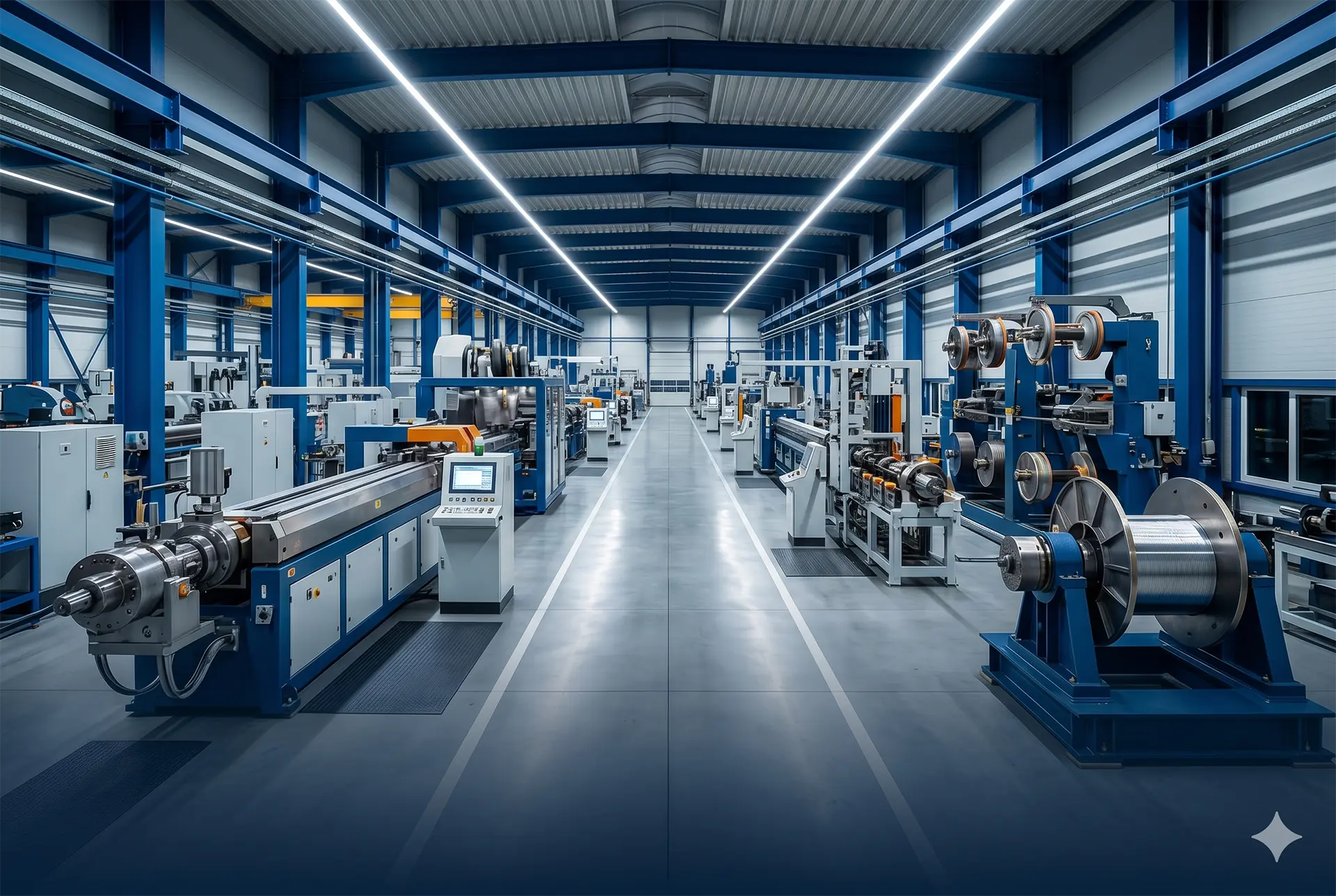

The cable machinery sector is undergoing one of the most significant shifts in its history. Driven by the convergence of digital technologies, evolving energy infrastructure demands, and global pressure to reduce industrial waste, cable machinery manufacturers and their customers are rethinking every aspect of how production lines are designed, operated, and maintained. This article examines the key forces reshaping the industry — and what cable manufacturers need to prepare for in the years ahead.
A Changing Landscape: Why Now?
For much of the 20th century, cable production was built around stable, linear processes — well-understood machinery, consistent raw material inputs, and predictable demand from construction and utilities markets. That stability is giving way to a more complex environment shaped by several converging forces.
The global transition to renewable energy is generating unprecedented demand for high-voltage and submarine cables connecting offshore wind farms, solar installations, and grid interconnectors. Electric vehicle infrastructure is driving growth in specialised automotive cable types. At the same time, data centre expansion is accelerating requirements for high-performance data transmission cables. Each of these trends demands not just more cables, but cables with tighter specifications, greater performance consistency, and faster production turnaround times.
Cable machinery manufacturers are responding by developing smarter, more integrated production systems — and the companies that adopt them earliest will define the competitive landscape of the next decade.
From Standalone Machines to Integrated Production Systems
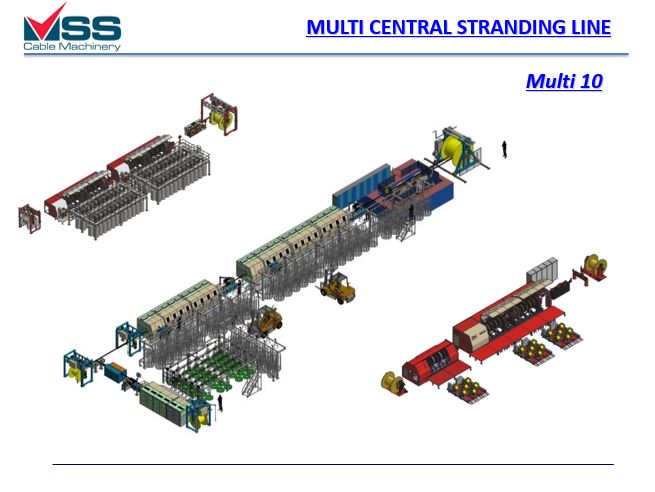
One of the most consequential shifts in cable machinery is the move away from standalone machines toward fully integrated production lines where every component communicates with every other. In traditional setups, an extrusion line, a stranding machine, and a taping unit might operate independently, with operators manually transferring settings, monitoring individual outputs, and reconciling data after the fact.
In a modern integrated production environment, these machines share a common data architecture. Process parameters flow automatically from the production order into each machine on the line. Output data — conductor diameter, insulation thickness, stranding pitch, take-up tension — is captured continuously and fed into a central system where deviations trigger immediate alerts or automatic corrections.
The practical impact of this shift is significant. Errors that previously went undetected until end-of-line inspection can now be identified and corrected in real time, reducing scrap rates and rework costs. Production handoffs between line sections that once required operator intervention now happen automatically, reducing idle time between runs. And the data generated by integrated lines creates a detailed production record for every meter of cable produced — invaluable for quality certification and customer documentation.
Intelligent Control Systems: Beyond Basic PLC Automation
Earlier generations of cable machinery relied on programmable logic controllers (PLCs) to automate individual machine functions — maintaining a target line speed, holding a set temperature, triggering a stop condition. This kind of automation improved consistency and reduced operator workload, but it was fundamentally reactive: the machine would respond to a condition once it occurred, but it could not anticipate problems before they developed.
The next generation of control systems incorporates a fundamentally different approach. By combining continuous sensor data with machine learning algorithms, modern control platforms can identify patterns that precede quality defects or mechanical failures — and intervene before the problem materialises.
A temperature variance in an extruder barrel that would previously have been logged and reviewed at the end of a shift can now trigger an automatic parameter adjustment within seconds, preventing a section of out-of-specification insulation from ever reaching the take-up drum. A subtle change in motor current draw that indicates increasing bearing wear can generate a maintenance notification days before any performance degradation becomes visible to an operator.
This shift from reactive to predictive control represents a meaningful improvement in both product quality and equipment uptime — two of the most critical metrics in cable manufacturing economics.
The Role of Industrial IoT in Modern Cable Factories
The Industrial Internet of Things (IIoT) is the infrastructure layer that makes integrated, intelligent manufacturing possible. At its most basic level, IIoT involves equipping production machinery with sensors and network connectivity so that operational data can be collected, transmitted, and analysed continuously.
In a cable factory built around IIoT principles, every machine — from the rod breakdown line at the start of the process to the rewinding and packaging equipment at the end — contributes data to a unified platform. This creates a real-time digital model of the entire production process, sometimes referred to as a digital twin, that gives operations managers a comprehensive view of what is happening across the factory floor at any given moment.
The benefits of this visibility extend across multiple dimensions of factory performance. Production scheduling becomes more accurate because bottlenecks and capacity constraints are visible before they cause delays. Maintenance planning becomes more efficient because equipment condition data replaces fixed-interval service schedules with condition-based interventions. Energy consumption can be tracked and optimised at the machine level, identifying opportunities to reduce operating costs without affecting output.
Beyond the factory walls, IIoT connectivity enables cable manufacturers to share relevant production data with customers, suppliers, and logistics partners in real time — creating a level of supply chain transparency that was practically impossible a decade ago.
Sustainability as a Design Principle, Not an Afterthought
Environmental performance has moved from a compliance consideration to a genuine competitive differentiator in the cable machinery sector. Customers — particularly large industrial and utility buyers operating under their own sustainability commitments — increasingly evaluate machinery suppliers on the energy efficiency of their equipment, the recyclability of production waste, and the long-term environmental profile of the materials used.
Modern cable machinery addresses these expectations through several design approaches. High-efficiency drive systems significantly reduce electricity consumption compared to older fixed-speed motor arrangements. Precision control of extrusion temperatures and speeds reduces polymer degradation, which in turn reduces material waste and the energy required to process it. Closed-loop cooling systems minimise water consumption in processes that require thermal management.
At a process level, integrated material tracking allows manufacturers to precisely account for raw material inputs and finished cable outputs, identifying where losses occur and creating opportunities to reduce scrap generation. In some production configurations, off-specification material that would previously have been discarded can be reprocessed and reintroduced into the production stream.
For cable machinery manufacturers, embedding sustainability into product design is no longer just about meeting regulatory requirements such as ISO 14001, RoHS, or REACH. It is about delivering equipment that helps customers meet their own environmental targets — which is increasingly a condition of doing business in key markets.
Modularity and Flexibility: Meeting Diverse Production Demands
One of the practical challenges facing cable manufacturers today is the growing diversity of cable types they are expected to produce. A factory that once specialised in a narrow range of power cables may now need to handle fire-resistant cables, armoured subsea cables, data transmission cables, and automotive wiring harness components — each with distinct processing requirements.
Rigid, purpose-built production lines struggle to accommodate this kind of variety efficiently. The answer lies in modular machine architectures that allow production configurations to be changed quickly as product mixes shift. Individual line sections — pay-off units, stranding heads, taping stations, take-up systems — can be reconfigured, added, or removed without requiring a complete line redesign.
This modularity reduces the capital cost of expanding into new cable types, shortens the time required to bring new products to market, and allows manufacturers to respond more quickly to changes in customer demand. For cable machinery suppliers, it also creates a foundation for ongoing customer relationships built around equipment upgrades and process support rather than one-time sales.
The Human Factor in an Automated Factory
Automation and digitalisation do not eliminate the need for skilled people in cable manufacturing — they change what those people need to know and do. The operator who once spent most of their shift monitoring a single machine now works across a networked production environment where their primary role is to interpret data, make decisions, and manage exceptions.
This shift requires a different skill set: familiarity with data analysis tools, the ability to interpret sensor outputs and control system alerts, and an understanding of how changes in one part of the production line affect performance downstream. Cable manufacturers that invest in developing these capabilities in their workforce are better positioned to realise the full value of the technology they deploy.
Machinery suppliers play an important role in this transition. Training programmes, intuitive human-machine interface design, and accessible remote support systems all contribute to making advanced production technology accessible to operators who may not have backgrounds in data science or software engineering. The goal is not to replace human judgment but to give the people on the factory floor better information to work with.
What to Expect in the Next Five Years
Several developments are likely to have a meaningful impact on cable machinery over the coming years. Artificial intelligence applications will move beyond predictive maintenance into more complex territory, including autonomous quality optimisation — where production parameters are adjusted continuously to maximise cable quality without operator intervention.
Digital product passports, already emerging in the European Union’s regulatory framework, will require manufacturers to document the material composition and production history of their products in verifiable digital form. This will further increase the value of integrated data collection infrastructure in cable production environments.
Additive manufacturing — while not yet applicable to high-volume cable production — may become relevant for producing specialised machine components with complex geometries, reducing lead times for spare parts and enabling greater customisation of tooling.
And as energy transition investments continue to grow, demand for the largest and most technically complex cable types — high-voltage direct current (HVDC) cables, offshore wind array cables, subsea interconnectors — will create opportunities for machinery manufacturers capable of building equipment to meet these challenging specifications.
Conclusion
The cable machinery industry is at an inflection point. The technologies that will define competitive advantage over the next decade — integrated control systems, IIoT connectivity, predictive analytics, sustainable design, and modular flexibility — are no longer emerging concepts. They are available today, and the manufacturers that deploy them effectively are already pulling ahead.
For cable producers evaluating their machinery investment strategy, the question is no longer whether to embrace smart manufacturing, but how quickly and comprehensively to do so. The factories that will lead their markets in 2030 are being built — and the decisions made today will determine which companies are in them.