

Modern cable production demands not only speed but also structural integrity, especially for cables deployed in demanding environments such as underground power grids, offshore installations, and industrial facilities. At the heart of this production process lies the Drum Twister — a high-capacity machine engineered to strand, assemble, and armour cable cores with exceptional precision. This guide examines how drum twister technology works, what makes it different from alternative stranding methods, and why it remains the preferred solution for heavy-duty cable manufacturing worldwide.
What Is a Drum Twister and How Does It Work?
A Drum Twister is a large-scale industrial machine used to twist multiple cable cores around each other and apply protective armouring materials in a single, continuous operation. Unlike conventional stranding machines, the drum twister rotates the entire cable drum during production, which allows it to process significantly longer cable lengths and much heavier cross-sections without compromising structural consistency.
This rotating drum mechanism makes the drum twister particularly well-suited for power transmission cables, subsea cables, armoured multi-core cables, and fibre optic assemblies — all of which require precise lay length control and reliable mechanical protection.
Drum Twister Configurations: Type 1 and Type 2
Drum twisters are available in two primary configurations, each optimised for different production requirements:
Type 1 — Single-Core Stranding: Designed for straightforward twisting operations involving single-core cables. This configuration offers high throughput with a simplified setup, making it ideal for standard power cable production lines.
Type 2 — Multi-Core Assemblying: Built for more complex cable structures that involve multiple insulated cores. The Type 2 configuration provides enhanced tension control and greater flexibility during the stranding process, ensuring accurate core positioning across the full length of the cable.
Both configurations share the fundamental advantage of the drum twister design: the ability to process heavy, large-diameter cables without placing excessive mechanical stress on the conductor or insulation materials.
Drum Twister vs. Rigid Strander: Which One Is Right for Your Production Line?
Selecting the right stranding technology is a critical decision for any cable manufacturer. The two most common options — Drum Twister and Rigid Strander — differ in design philosophy, production capacity, and application range.
Working Mechanism: A drum twister rotates the entire cable drum, enabling it to handle large, heavy cable assemblies over long production runs. A rigid strander, by contrast, keeps the drum stationary and rotates only the individual bobbins around a central axis, resulting in a more compact footprint and higher rotational speed for smaller cables.
Production Capacity: Drum twisters excel in high-capacity production of long cable lengths — particularly important for subsea and high-voltage applications where uninterrupted cable runs are required. Rigid stranders are better suited to lighter, shorter-length cables where production speed and energy efficiency take priority.
Application Areas:
| Drum Twister | Rigid Strander |
|---|---|
| High-voltage power cables | Low and medium-voltage conductors |
| Armoured multi-core cables | Communication and data cables |
| Subsea and underground cables | Small-diameter wires |
| Optical fibre assemblies | Standard industrial cables |
In summary: for heavy, armoured, or large-scale cable types, the drum twister is the superior choice. For lighter, standardised, high-speed production, a rigid strander offers a more economical solution.
Key Components of a Drum Twister Line
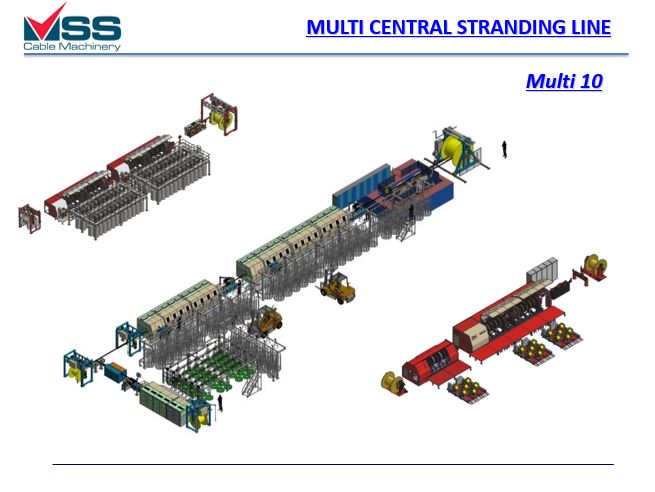
The performance of a drum twister system depends on the precise integration of multiple line components. Here is an overview of the essential equipment:
Rotating Pay-Off (2500 / 1600 mm) The pay-off unit controls the unwinding of cable drums at the start of the line, maintaining consistent tension as the material feeds into the twisting process. The 2500/1600 mm configuration accommodates large-diameter drums, making it suitable for high-capacity production runs.
Rotating Take-Up (2500 mm) At the output end of the line, the rotating take-up winds the finished cable onto the drum. Proper synchronisation between the pay-off and take-up is critical to maintaining uniform lay length and preventing torsional stress in the finished cable.
Rotating Caterpillar (1800 kgF) This component provides the pulling force needed to move the cable through the entire line at a controlled and consistent speed. With a capacity of 1800 kgF, it ensures smooth progression even for the heaviest cable cross-sections.
Die Stand and Length Counter The die stand shapes the assembled cable to its target outer diameter, while the integrated length counter provides real-time production tracking — an essential function for order-specific cable manufacturing and quality documentation.
Guide Rollers Guide rollers maintain proper cable alignment and tension distribution throughout the line, preventing lateral movement that could affect the accuracy of the stranding or armouring process.
Sector Core Deflecting Unit For cables with sector-shaped conductors, this unit repositions the cores prior to armouring, preserving the geometric integrity of the cable cross-section and ensuring optimal current-carrying performance.
Steel Taping Machine Steel tape is applied by this unit to provide the outer armouring layer, significantly increasing the cable’s resistance to mechanical impact, compression, and rodent damage — particularly important for buried or exposed installation environments.
Paper Taping Machine Where additional insulation or separation between layers is required, the paper taping machine applies a paper wrap around the cable assembly. This is particularly common in high-voltage and telecommunication cable designs.
Electrical Control Cabinet The centralised control cabinet coordinates all line components in real time, ensuring synchronised operation, consistent lay pitch, and stable processing speeds throughout the production run.
Extended Equipment Options
For large-scale or special-purpose cable projects, extended equipment configurations are available:
3000 / 3600 mm Rotating Pay-Off and Take-Up These oversized units are designed for extra-heavy cable drums used in subsea, offshore, or high-voltage transmission projects. Their larger capacity reduces the number of drum changes during production, increasing overall line efficiency.
Why Drum Twister Technology Matters for Modern Cable Production
Structural Reliability: The rotating drum mechanism ensures a consistent and controlled lay length across the entire cable length, which directly affects the electrical and mechanical performance of the finished product.
Process Integration: Multiple production steps — stranding, taping, and armouring — are completed within a single pass through the line, reducing handling time and the risk of damage between processes.
Production Flexibility: With interchangeable tooling and configurable take-up options, drum twister lines can be adapted to produce a wide range of cable types without requiring a complete line reconfiguration.
Scalability: From standard power cables to subsea umbilicals and extra-high-voltage transmission cables, drum twister technology scales to meet the requirements of virtually any cable manufacturing operation.
Frequently Asked Questions
What types of cables are produced on a drum twister? Drum twisters are used for a wide range of cable types, including armoured power cables, multi-core control cables, subsea cables, and fibre optic assemblies.
What is the main advantage of a rotating drum design? The rotating drum eliminates the length restrictions associated with bobbin-based stranders, allowing continuous production of very long cable runs without intermediate joins or splices.
Can a drum twister line be customised for specific cable designs? Yes. MSS Machinery drum twister lines can be configured with different pay-off and take-up drum sizes, taping heads, armouring units, and control systems to match the specific technical requirements of any cable type.
How does armouring improve cable performance? Armouring adds a layer of steel wire or tape around the cable core, protecting it from mechanical damage, moisture ingress, and external pressure — significantly extending the service life of cables in harsh installation environments.
Conclusion
The drum twister remains one of the most versatile and capable machines in the cable machinery sector, offering a unique combination of stranding precision, armouring capability, and production scalability. For cable manufacturers working with power, subsea, or armoured cable types, investing in a well-engineered drum twister line is one of the most effective ways to ensure consistent product quality and long-term production efficiency. MSS Machinery designs and manufactures drum twister lines built to meet the most demanding technical specifications — from standard industrial cables to complex, multi-layer armoured assemblies.